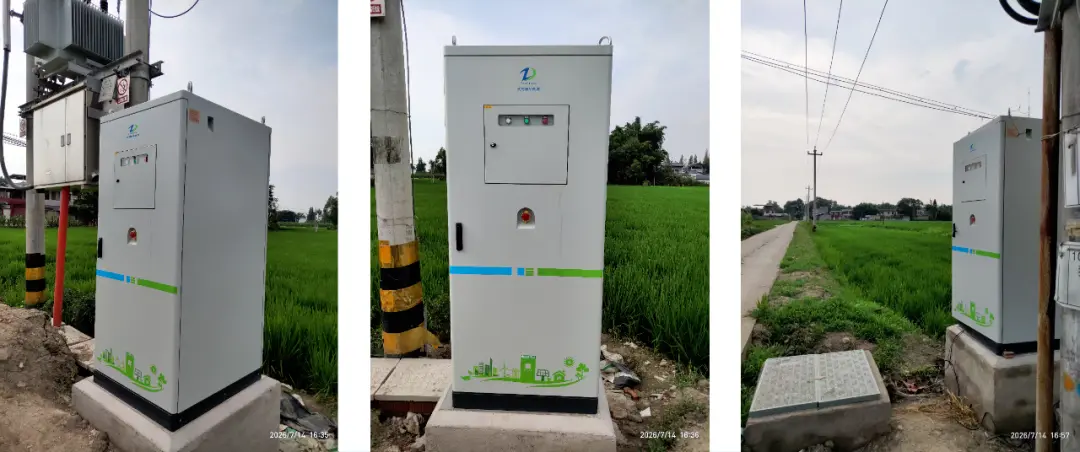
After years of working deeply in the low-voltage distribution network field, one thing has become increasingly clear:
Many distribution transformer area problems are not caused by insufficient power supply capacity, but by inefficient power allocation.
Across countless project sites, we have encountered similar operational challenges:
The overall power supply capacity of an area is sufficient, yet some distribution transformer areas suffer from continuous overloads and frequent trips, while others remain lightly loaded for most of the time with significant unused capacity.
This is a common limitation of traditional distribution networks:
Each transformer operates as an independent “energy island”, working separately without coordination or power sharing.

During summer seasons and evening peak demand periods, residential communities often experience sharp increases in electricity consumption.
Air conditioners, household appliances, and EV charging loads operate simultaneously, causing transformer loads to surge rapidly.
Transformers operate under high temperatures, terminal voltage drops, and overload protection trips become frequent occurrences.
Operation and maintenance teams have to repeatedly perform temperature monitoring, inspections, and temporary voltage adjustments. Overnight emergency repairs become routine.
However, these measures only address symptoms rather than the root cause, and customer complaints regarding power quality and reliability remain high.
What is even more challenging is that commercial areas and office buildings located only a few hundred meters away often have very low loads after business hours.
Their transformers remain lightly loaded throughout the night, leaving large amounts of available capacity unused.
One area is overloaded and operating under stress, while another wastes valuable capacity.
Despite their close physical distance, they cannot support each other.
With the rapid growth of rooftop photovoltaic installations in rural areas and residential communities, this imbalance has become even more pronounced.
During the daytime, when residents are away, rooftop PV generates large amounts of electricity. However, local consumption is insufficient, resulting in PV curtailment and generation limitations.
At night, when residents return home and electricity demand rises sharply, the same distribution transformer areas face overload pressure again.
This creates a cycle of:
“Energy wasted during the day, insufficient capacity at night.”
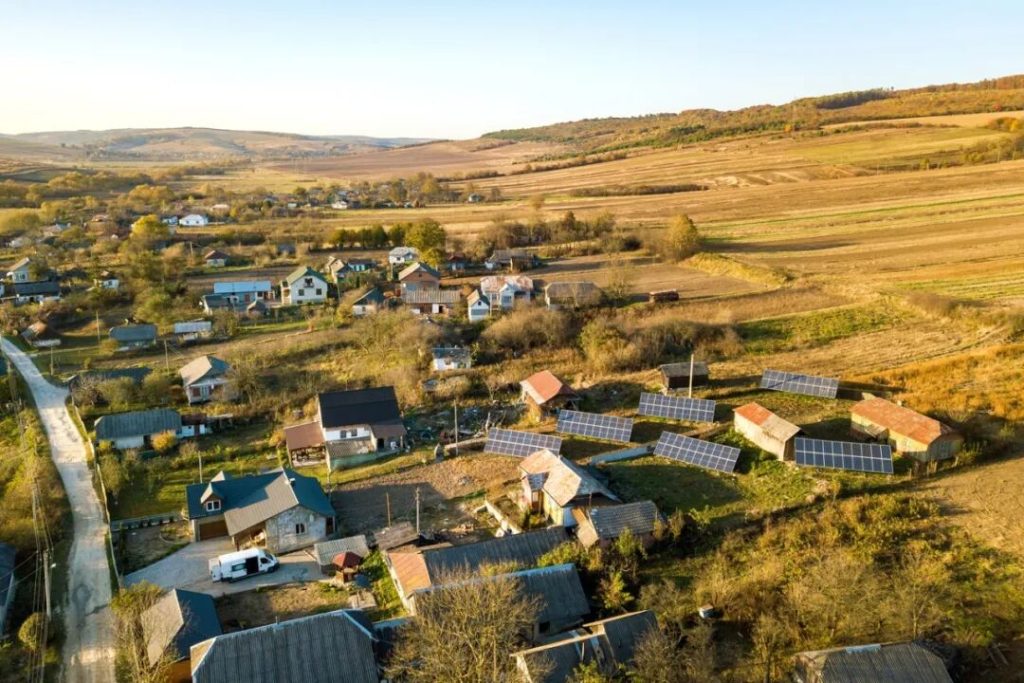
Previously, the solution was straightforward but costly:
Wherever overload occurred, additional transformers and upgraded power lines were installed.
However, many existing residential areas have limited available space, and urban village redevelopment is complex.
New equipment installation requires:
- High investment costs
- Long construction periods
- Increased basic capacity charges
- Higher long-term operation and maintenance expenses
The overall economic efficiency is often poor.
In reality, most existing distribution transformer areas do not lack capacity — they lack intelligent coordination and mutual support.
To break this bottleneck, large-scale reconstruction is unnecessary.
The key solution is to break the isolation between distribution transformer areas and enable bidirectional power sharing between heavily loaded and lightly loaded areas.
The core equipment enabling this solution is the Power Router.
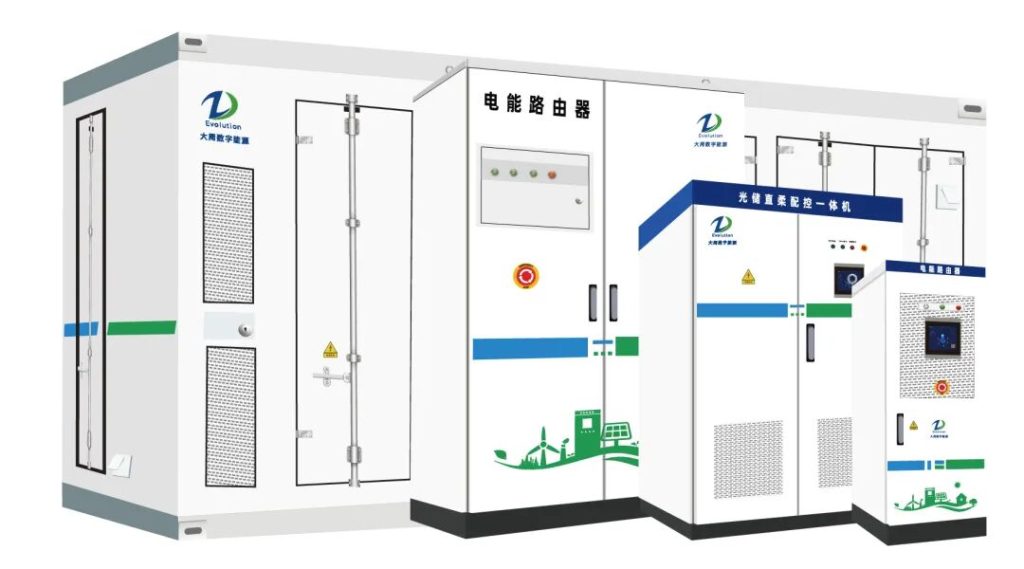
Unlike traditional AC interconnection methods, which may suffer from circulating currents, transient current impacts, and difficulties in continuous operation, GCEVO Energy Power Router adopts a proven 750Vdc DC bus coupling architecture.
This approach fundamentally avoids grid safety risks and enables millisecond-level precise power regulation, allowing distribution transformer areas to achieve:
- Safe interconnection
- Controllable power exchange
- Long-term stable operation
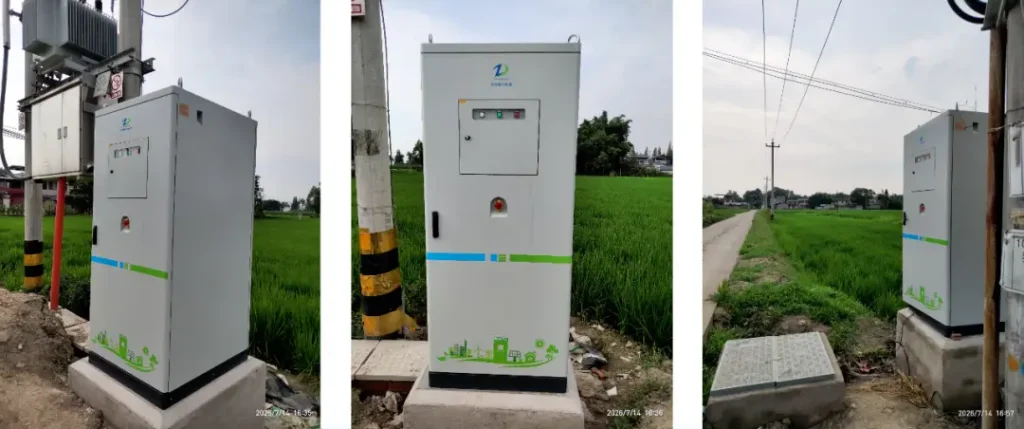
This project adopts two standardized Power Router units with identical hardware configurations.
The standardized design provides:
- High equipment compatibility
- Strong operational stability
- Simplified maintenance and service
The hardware platform is universally adapted to dual-grid operating conditions, while customized software algorithms are deployed according to the load characteristics of different distribution transformer areas.
This achieves:
“Standardized hardware + customized intelligent dispatching”
to precisely match different application scenarios.
The system supports bidirectional power exchange with:
- Grid voltage: 380Vac ±10%
- Frequency: 50Hz
- Rated single-port capacity: 125kVA
The project adopts differentiated port configurations:
- One side is equipped with a 130kW isolation transformer to adapt to complex insulation conditions in aging distribution areas.
- The other side adopts a non-isolated configuration to reduce equipment costs while balancing safety and economic efficiency.
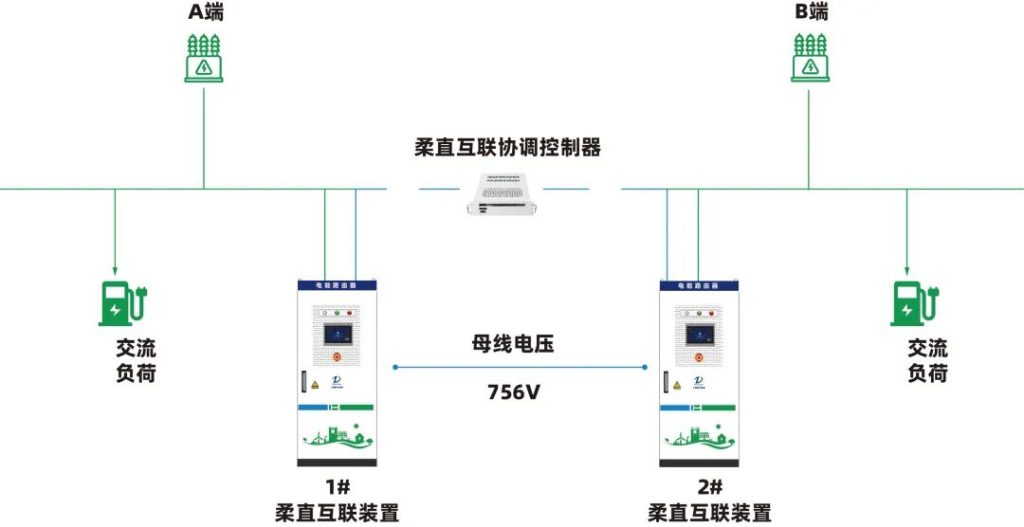
This lightweight grid-only interconnection solution requires no additional PV or energy storage systems.
It directly targets the core challenge of traditional distribution transformer areas:
load imbalance.
With low deployment requirements and rapid improvement after installation, it provides an efficient upgrade path for existing distribution networks.
Supported by dedicated distribution transformer area load-balancing algorithms, the system operates intelligently 24/7:
- During peak demand periods, it dynamically transfers power to increase available capacity.
- During low-demand periods, it absorbs excess power capacity.
- It simultaneously improves power quality by addressing:
- Three-phase imbalance
- Voltage drops
- Other low-voltage network issues
In the event of line faults, the system can complete fault isolation and self-healing within milliseconds, significantly reducing outage duration and achieving multi-functional operation through a single device.
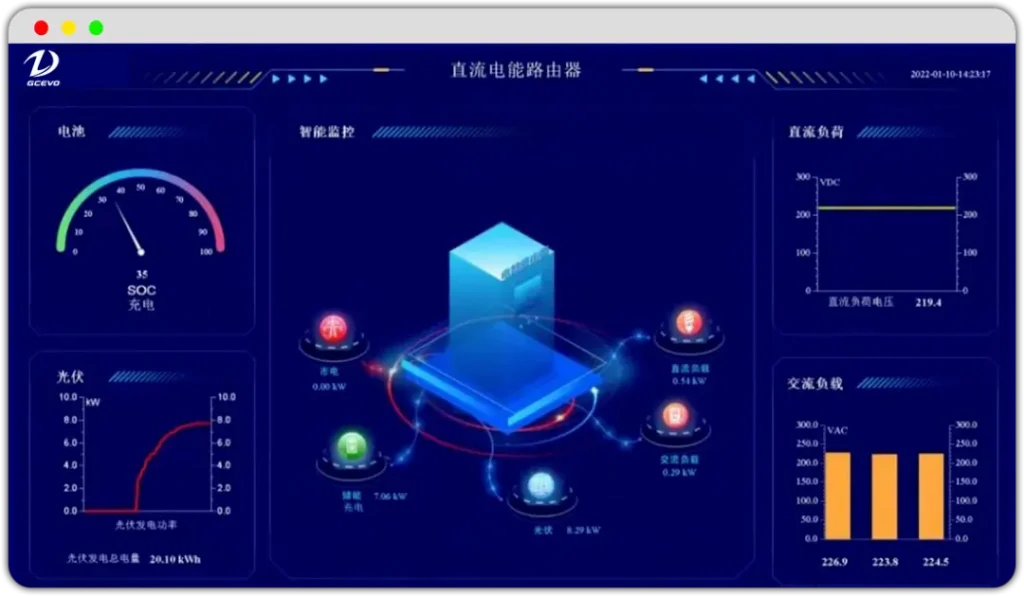
The improvements after deployment are highly visible:
Without adding new transformers, the system achieves dynamic virtual capacity expansion, reducing excessive transformer loading back to safe operating levels.
Benefits include:
- Reduced equipment investment
- Lower basic electricity capacity charges
- Better utilization of existing transformer capacity
- Elimination of wasted grid resources
- Reduced transformer trips and outage frequency
- Improved user electricity experience
Meanwhile, the system reserves expansion interfaces for future upgrades.
It can seamlessly integrate:
- Photovoltaic systems
- Energy storage systems
- DC charging stations
supporting future upgrades toward:
- PV-storage-DC-flexible energy systems
- Zero-carbon distribution transformer areas
One investment enables continuous future expansion.
The era of traditional distribution network upgrades based solely on capacity expansion is coming to an end.
The future direction is:
Unlocking existing assets, intelligent energy dispatching, cost reduction, and efficiency improvement.
Distribution transformer area flexible interconnection provides an optimal pathway for solving uneven load distribution in low-voltage networks.
With its independently developed Power Router technology, GCEVO Energy provides a powerful foundation for low-cost upgrades and large-scale deployment of existing distribution transformer areas.
发表回复